
Short leads, tall follows, and the context trap
0: Intro
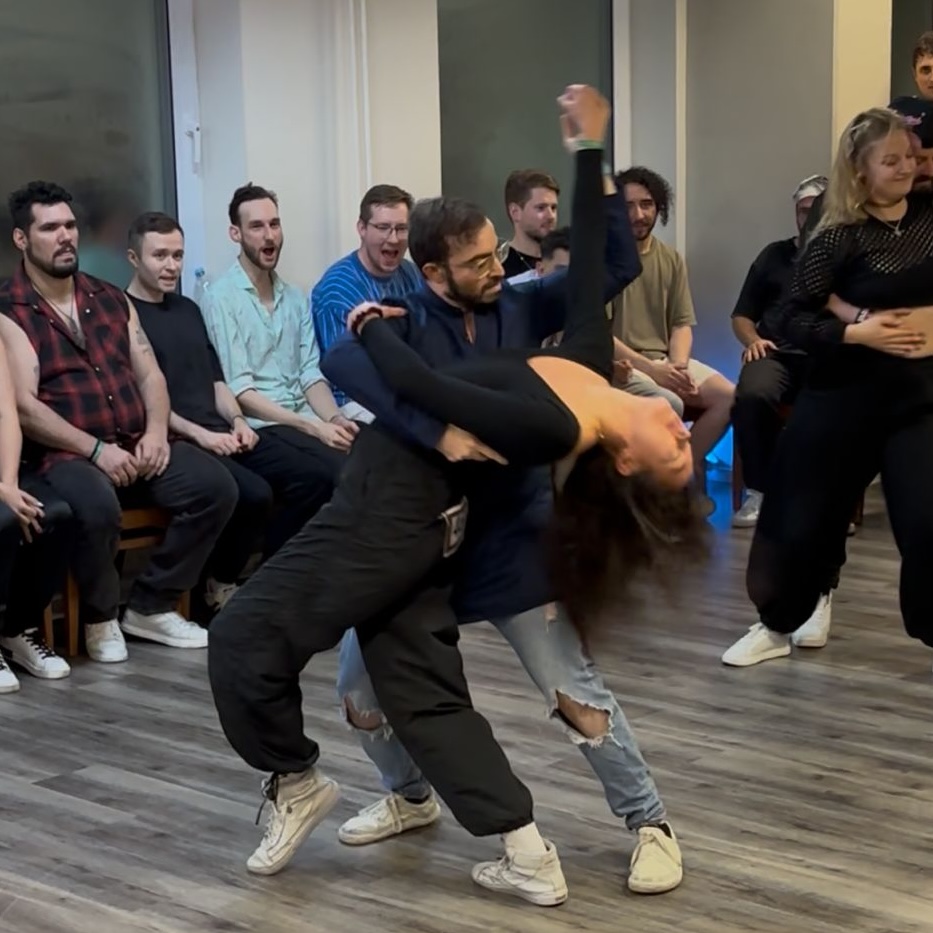
After Adarsh and I competed together in Hamburg (giving what is to date, at least for me, the JnJ performance of which I am the most proud), we received a lot of compliments on our connection, our technical execution of hard movements, and our musicality. However, overwhelmingly, the most common thing people noted was our height difference. To Adarsh: “You got the tallest girl!” To me: “I was afraid at first because you picked the shortest lead.”
To be honest, in the moment, when I had pulled Adarsh’s name from the cup, I was relieved. He is one of my oldest friends in Zouk and the lead who out of all the leads competing that day I was the most comfortable dancing with. And we killed it! But afterwards we had some long discussions (actually, some more long discussions, because we had had plenty before) about height differences in Zouk. And here I want to address a few points in detail, but the thesis is the following:
Judgments about how difficult/easy, beautiful/ugly, impressive/boring Zouk is based on height differences are often due to unconscious biases from a dance context that has codified a specific body type (and thus a specific aesthetic) as standard.
Why is this important? Because it doesn’t just apply to height. Many of the things I will talk about will apply to other “non-traditional” dance aesthetics: weight, gender non-conformity, age, race. We dance a social dance– as a dance it remains a subjective art, as a social dance it is subject to all the same social issues we see in society at large. On the social dance floor, in a JnJ judging panel, in class, and in training, we need to be aware of the wider context of the dance and our own biases about it to keep it as accessible to all as possible. Why and when do we think the dance is beautiful? How does it affect who we ask to dance and who we train with, who we consider “good” and who isn’t? Who wins competitions and who doesn’t?
Part 1: Why is it harder to dance with shorter leads/ taller follows?
I have a thought-exercise I am quite fond of. Imagine, for a moment, that for every artist or teaching couple in the world today, the follow is 20 cm taller than the lead. What kinds of moves would appear most often in demos? What kind of moves would they be teaching? What kind of moves would get the most cheers in JnJ?
Now return to reality, to the context of our dance. We live in a world where the opposite is practically true. And so is it any wonder that the “cool moves” we love in Zouk, the moves teachers create and post, are ones which are engineered to work well when the lead is taller and the follow is shorter?
This is what I mean by the context of the dance. We live in a world today where Zouk as a dance is dominated by moves which are easier with two people who have a certain body type. Now, importantly, this is not a bad thing. I am a very tall follow — but I love tilted turns and toalhas. I love counterbalances. I would be very sad if Zouk lost these moves.
However, the physical reality is that for taller follows and shorter leads, perfect technique and adaptations for these moves are necessary for them to function (see Footnote 1). This is what makes the dance seem harder. Note: “seem” harder!
I want to emphasize this: height difference does not make Zouk harder. Height difference makes Zouk harder in the context that we dance it today. I think this is an important distinction because it removes the identity aspect of the difficulty. It’s not that you are too tall to be a follow or too short to be a lead. The problem is not with you and this thing about yourself you can’t change. The problem is with the dance itself and how we as a community develop it. The problem is not you. The problem is context.
At least for me, it was very important for my own self-esteem as a dancer to realize this.
In fact, realizing that difficulty in Zouk is due to context and not identity gives us an opportunity — we can change context! There are so many amazing moves that exist or have yet to be dreamed up where a taller follow would indeed have the advantage. Our arms were made for the most beautiful wifi bonecas! What kind of insane pretzels could we come up with? What stops the lead from going under legs instead of the follow going under their arms?
It’s up to us, the Zouk community, to recognize that the dance is not inherently “harder” for taller follows and shorter leads, and that we have the power to change this if we wish. Then we can have faith when we’re doing our pistol squats in the gym to make one legged spins work that we were meant to do this dance, we are Zoukers, and we are just practicing this one difficult move that happens to be harder for us.
Part 2: Aesthetics and what it means to dance “beautifully.”
So we (hopefully) now agree about what we mean when we say that Zouk is harder for tall follows and short leads. Not harder in an absolute sense, but harder in the context of what we choose to learn and do on the social dance floor.
I want to talk about one important consequence of height difference that shows up a lot in things like demos, competitions, etc, which is aesthetics. One common thing I hear a lot is that taller follows and shorter leads simply “look” a lot worse dancing together than the other way around. Many times I happen to be dancing with an extraordinarily tall lead and people will tell me we “fit well” or “look good.”
Why does this happen? Context again is the culprit. Traditional dance lines mandate long arms, long (unbent legs), erect posture. For the moves that we choose to do, these lines are often impossible for taller follows and shorter leads.
So if they’re ugly, should we then choose to not do them? Bullshit! Remember why we social dance — for the joy of understanding a new body and making art together (Footnote 1!). For me the far better answer is to change what we think of as “beautiful.”
Why shouldn’t it be beautiful, that the follow must bend their knees to do a tilted turn? Why shouldn’t it be beautiful, when a follow looks like they’re flying in a counterbalance because the lead is so much shorter they’re obstructed from view?
I get that subjective senses of beauty can’t be altered by pure will alone (though they may not be as permanent as you think — see Footnote 2). You are free to think what you think is beautiful.
But if you are, for example, a judge in a JnJ competition, you should be aware of where your sense of aesthetics is coming from, and who it advantages and disadvantages. If you think a tilted turn was “messy” purely because the follow had to bend their legs and take away points — have you done the right thing? If you are a teacher teaching a private, should you really tell a lead never to lead one legged spins because they won’t look as nice as when his 190cm friend does them? This brings me to the last section.
Part 3: Practical consequences and recommendations
I want to focus here on JnJ judging in particular — while personal aesthetic sensibilities will always vary widely, JnJ judgements are a place where opinions about aesthetics have real consequences.
We have heard from a noted JnJ judge (who will remain unnamed) that in a pair where the lead is short and the follow is tall, traditional moves such as tilted turns and one-legged spins should simply be avoided — rather than adapting to make these moves possible, we should limit our repertoire of movements to include only moves which are traditionally “aesthetic.” In fact one of the major pieces of feedback Adarsh and I got on our JnJ dance was that we “took too many risks.”
This view is a severe disadvantage to couples with non-traditional height differences. Non-traditional pairs must be exponentially more creative and come up with a completely different repertoire of moves in the tense 2 minutes of a JnJ dance just to stay on a level playing field with couples who fit the standard height mold and can “aesthetically” use the most contextually common Zouk moves today (tilted turns, one-legged spins, toalhas). When couples with the standard height difference benefit from this view by systematically doing better in competition, judges are unconsciously promoting the status quo of the body types that we are used to seeing to stay prevalent.
I claim that physical adaptation to the most common moves in Zouk given a non-traditional height difference is something worthy of reward rather than censure. In my mind, the kind of adaptations required to execute these challenging movements deserves more points, not less.
In fact, in JnJ we already have a mechanism to reward physical adaptation— we just only use it when it fits a traditional gendered aesthetic. When follows in JnJ wear high heels, at the judge’s discretion, they can receive extra points in the “Difficulty” section if they can successfully pull off the same moves as a follow who doesn’t wear high heels. We collectively acknowledge that heels change the center of gravity and make the dance harder, so we reward the dancer for overcoming that self-imposed challenge.
This is hypocritical: traditional aesthetics (heels) are rewarded, while non-traditional aesthetics (tall follow/short lead) are unconsciously penalized, even though both require challenging adaptations between partners (and in fact the latter is a physical reality instead of a shoe choice).
Of course, I see the impracticality of the idea of giving a pair more points because they are taller/ shorter. So to me the fairest solution is the following: no points for physical adaptation. No points for heels, no points for being taller. And, importantly, no deductions for aesthetic judgements based on height adaptation.
Short leads and tall follows have learned, through hard work, adaptations that will allow us to dance with anyone — and it may lead to a different aesthetic of the dance, but one that reflects the challenges of executing difficult movements with good technique. Let the scoring for this, a social dancing competition, be based instead on what really matters — how strong the connection is between lead and follow based on their adaptations to each other. These adaptations are beautiful. These adaptations are necessary. And at the end of the day, these adaptations are what it means to dance Zouk.
Some recommendations:
- Let’s talk more about height adaptation and technique. Adarsh and I are happy to share what we’ve learned about this, and others should, too!
- Get rid of the heels rule in JnJ! There should be no points rewarded or taken away for abstract “aesthetic” judgements based on a dancer’s body type and the adaptations required to use certain moves in a social dance.
- Teachers, please be very cognizant when you are telling leads they are too short to lead a move on a taller follow, or to a taller follow that they are too tall to follow certain moves. These kinds of statements can be so harmful to a developing dancer, and are usually absolutely untrue.
- Judges in competition should be aware when they are taking away points in competition for “aesthetics” that are biased towards certain populations (this applies not just to short leads/ tall follows, but could also be related to weight, age, etc.)
- In class or in social, don’t immediately assume that things will be “harder” with someone who is shorter or taller than you in the wrong direction. These comments really suck, and tall follows and short leads are sick of hearing them.
Do you have feedback or thoughts on this article? Please feel free to leave comments on the source document here!
Footnote 1: Adapting for height and good technique are important
This section goes at the end because while I think it’s important to acknowledge, I don’t find it the most interesting or groundbreaking thing in this essay.
An axiom: there are always adaptations available to you. That is the beautiful thing about social dance. A social dance is inherently a challenging situation — you may be totally unfamiliar with your partner, their body, their movement, even the music, and together you two are charged with creating art. The best social dancers in the world are so because they have learned how to mold their bodies to others’ seamlessly. And the magic in that is, when this is a skill you are good at, you can make anyone physically comfortable with you and create art with anyone. I think anyone who dances Zouk (or any other social dance seriously) would agree that this is a goal of theirs — otherwise why not just dance solo? 🙂
Height poses some obvious challenges. Many moves that are common in Zouk (tilted turns, toalha, one legged spins, anything under the arm, etc.) work better with a taller lead and a shorter follow. However, there are some obvious things we can do to compensate in these situations — in tilted turns the follow can bend their legs, the lead can invite points of contact, etc.
I think everyone will agree that it is essential to learn how to adapt for height, no matter what your height is. I have met some tall follows who shy away from dancing with leads shorter than them. But you’re missing a whole universe of leads who have learned already to adapt to you, if you’d give them a chance! A lead who is taller than 90% of follows may be much more likely to bump the head of the one poor follow who happens to be taller than they are.
Not only do you need to learn how to adapt to height, you should not rely on height difference to make up for poor technique. Counterbalance is a good example: many leads take advantage of the fact that they are bigger than their follows to drag them around in crazy counterbalances — follows in this situation will throw their weight anywhere relying on their leads to muscle them into not falling. I’m not going to argue this point too hard, because I think it should be obvious to anyone who social dances why this is a bad idea.
Adarsh and I have long talked about doing a height adaptation workshop and going over some of the specific techniques we use to adapt live in class. This is still an ambition of ours.
Footnote 2: Personal aesthetic sensibilities are not as permanent as we might think.
Really insightful observation by Shane Clark.
We have a higher degree of neuroaesthetic plasticity than we realize. For example, standards of beauty are changed all the time, often intentionally by marketing agencies. We can train ourselves as individuals and as a community to expand our perceptions of beauty by intentionally choosing to expose ourselves to content (virtually and in person) that align with our values of inclusion and diversity. By practicing active noticing and appreciation of certain characteristics and attributes, we train our brains to perceive them as beautiful.
“Quem ama o feio, bonito lhe parece”

About: Kyelee Fitts

You may also like...


Sorry - Comments are closed