
Is Zouk sexual?
En🇺🇸
Es🇨🇴↓
The sexualization of dance is one of those uncomfortable topics we almost never address with honesty. Most of the time, we choose extremes: either we deny it or we censor it. But dance, like any form of human expression, does not exist in black and white.
For me, dance works like a conversation.
And a conversation can be soft, deep, playful, absurd, sensual… or sexual.
A sexual conversation is not inherently good or bad. Sometimes it is even necessary. What truly makes the difference is the context, the intention, and how all the people involved feel within that exchange.
Movement is no different.
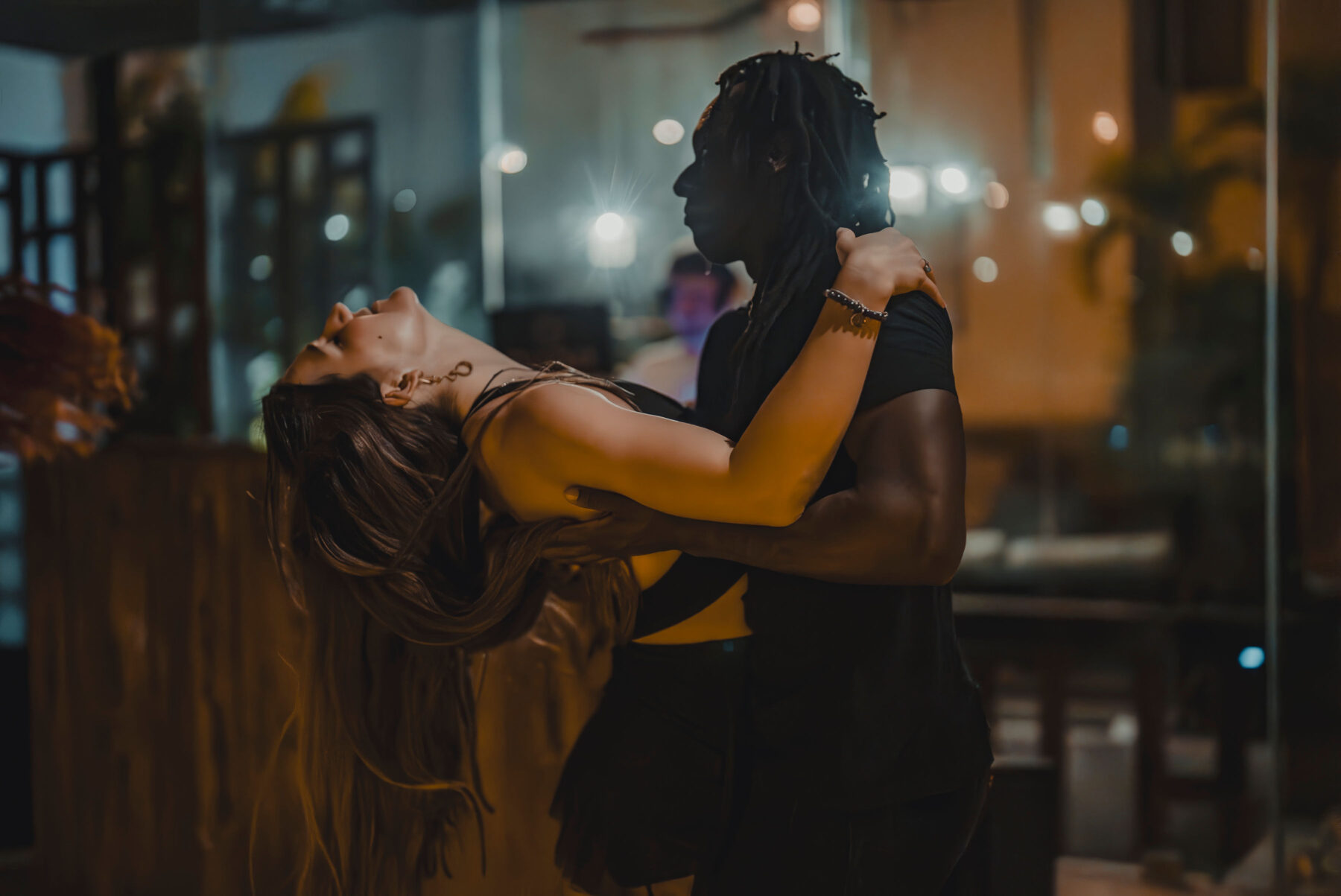
The body is not neutral. It never has been. To pretend that social dance should be completely stripped of sensuality or sexuality is to ask the body to stop being human. Especially in dances where connection and contact already live very close to intimacy, like in Zouk.
The problem is not that dance can express sexuality.
The problem appears when there is no context, no consent, or when one expression is imposed upon another without being reciprocated.
Context: what is almost always lost.
What happened at the events that recently caused controversy were spontaneous moments. Moments created precisely to explore and play. They were not Jack & Jill competitions. They were not meant to represent “what Zouk is,” nor to draw an aesthetic or ethical line for the community.
Yes, a line was crossed. I say that without drama.
But that line has nothing to do with whether the movement or the activities were “sexual.” It has to do with what happened afterward.
Within the space and context, among adults, with shared energy and implicit consent, those moments were experienced as light, playful, and without discomfort. For those of us who were there, that was simply what it was.
The conflict appears when that moment leaves its context and becomes public content, subject to external gazes, moral judgments, and interpretations that were not present in the original space.
Posting is not neutral.
Recording and posting are not the same as living.
Many times, the camera and the act of posting change the narrative.
A playful or provocative moment can exist with complete lightness within a safe space, yet acquire an entirely different weight when it is taken out of that safe space and presented without explanation, without framing, and without clear intention. Especially on social media, where there is also a potential audience—curious people who are just discovering the magic of Brazilian Zouk.
Perhaps the line that was crossed was not in the movement itself, but in the lack of awareness about what it means to expose those moments to a much wider community, with different codes, sensitivities, and expectations.
That is why I understand the concern about the image of the dance in such a public context. What I do not agree with is the position of control and censorship within the dance. Because the real problem here is not sexuality. It is the lack of honest conversation about it.
Sexuality does not make the dance less artistic.
It does not make it less respectable.
It does not make it dangerous.
What truly harms it is:
- Moralizing someone else’s body from a distance.
- Publicly ridiculing real people.
- Judging without having been there.
- Forgetting that every body has its own boundaries.
If we want to talk about respect for Zouk, we also have to talk about respect for individuals.
Dance does not have to be perfect or politically correct. Social dance is not a curated choreography made for social media. It is a living, imperfect, cultural, and emotional space. Sometimes it is deep, technical, clumsy, sensual, or chaotic.
And when we try to control how people express or post it, we often generate the opposite reaction of what we intend. We end up drawing even more attention to what we are trying to censor. We end up creating resistance and rebellion.
Maybe the focus should not be on condemning and trying to control everything that is shown, but on finding tools to promote Zouk in the ways we want it to be recognized. Supporting what we do want to see. Educating. Caring. Elevating what is beautiful in this community.
So, is Zouk sexual?
It can be.
But the fact that it can be does not mean it always is, nor that it should be in every space. Let it exist in contexts where it is safe, consensual, and conscious. And let us be responsible when we decide to bring those moments into a space as wide and permanent as social media.
Because Zouk is much more than that.
And reducing it — whether to defend it or to attack it — is also losing the context.
¿Es Zouk sexual?
Es🇨🇴
La sexualización del baile es uno de esos temas incómodos que casi nunca abordamos con honestidad. La mayoría de las veces preferimos los extremos: o lo negamos o lo censuramos. Pero el baile, como cualquier forma de expresión humana, no vive en blanco y negro.
Para mí, el baile funciona como una conversación.
Y una conversación puede ser suave, profunda, divertida, absurda, sensual… o sexual.
Una conversación sexual no es mala ni buena en sí misma. A veces incluso es necesaria. Lo que realmente marca la diferencia es el contexto, la intención y cómo todas las partes involucradas se sienten dentro de ese intercambio.
El movimiento no es distinto.
El cuerpo no es neutral. Nunca lo ha sido. Pretender que el baile social deba estar completamente desprovisto de sensualidad o sexualidad es pedirle al cuerpo que deje de ser humano. Especialmente en danzas en las que la conexión y el contacto ya se viven muy cerca de lo íntimo, como en el Zouk.
El problema no es que el baile pueda expresar sexualidad.
El problema aparece cuando no hay contexto, no hay consentimiento o cuando una expresión se impone sobre otra persona.
Contexto: lo que casi siempre se pierde.
Lo que ocurrió en los eventos donde hubo revuelo recientemente fueron momentos espontáneos. Momentos creados justamente para explorar y jugar. No eran Jack & Jill de Zouk. No tenían la intención de representar “lo que es el Zouk”, ni de marcar una línea estética o ética para la comunidad.
Sí, se cruzó una línea. Lo digo sin dramas.
Pero esa línea no tiene que ver con que el movimiento o las actividades fueran “sexuales”, sino con lo que pasó después.
Dentro del espacio y contexto, entre adultos, con energía compartida y consentimiento implícito, esos momentos se vivieron ligeros, divertidos y sin incomodidad. Para quienes estuvimos ahí, fue simplemente eso.
El conflicto aparece cuando ese momento sale de su contexto y se convierte en contenido público, sujeto a miradas externas, juicios morales y lecturas que no estuvieron presentes en el espacio original.
Publicar no es neutro.
Grabar y publicar no es lo mismo que vivir.
Muchas veces la cámara y la publicación cambian la narrativa.
Un momento juguetón o provocador puede existir con total ligereza dentro de un espacio, pero adquirir un peso completamente distinto cuando se saca de ahí y se presenta sin explicación, sin marco y sin intención clara. Sobre todo en redes sociales, donde también está el público potencial, curioso, que apenas está descubriendo la magia del Zouk brasileño.
Tal vez la línea que se cruzó no fue en el movimiento en sí, sino en la falta de conciencia sobre lo que implica exponer esos momentos a una comunidad mucho más amplia, con códigos, sensibilidades y expectativas diferentes.
Por eso entiendo la preocupación sobre la imagen del baile en un contexto tan público. Lo que no comparto es la postura de control y censura en el baile. Porque el verdadero problema no es la sexualidad. Es la falta de conversación honesta sobre ella.
La sexualidad no vuelve al baile menos artístico.
No lo vuelve menos respetable.
No lo vuelve peligroso.
Lo que sí lo daña es:
- Moralizar el cuerpo ajeno desde la distancia.
- Ridiculizar públicamente a personas reales.
- Juzgar sin haber estado ahí.
- Olvidar que cada cuerpo tiene agencia y límites distintos.
Si queremos hablar de respeto por el Zouk, también tenemos que hablar del respeto por los individuos.
El baile no tiene que ser perfecto ni políticamente correcto. El baile social no es una coreografía curada para redes. Es un espacio vivo, imperfecto, cultural y emocional. A veces es profundo, técnico, torpe, sensual, caótico.
Y cuando intentamos controlar cómo la gente lo expresa o lo publica, muchas veces generamos la reacción contraria a la que queremos. Terminamos llamando más la atención hacia aquello que queremos censurar. Terminamos generando resistencia y rebeldía.
Tal vez el enfoque no debería ser condenar y pretender controlar todo lo que se muestra, sino encontrar herramientas para promover el Zouk en las formas en que queremos que sea reconocido. Apoyar lo que sí queremos ver. Educar. Cuidar. Elevar lo que es bonito de esta comunidad.
Entonces, ¿es Zouk sexual?
Puede ser.
Pero que pueda serlo no significa que lo sea siempre, ni que deba serlo en cualquier lugar. Dejémoslo existir en los contextos donde es seguro, consensuado y consciente. Y seamos responsables cuando decidimos llevar esos momentos a un espacio tan amplio y permanente como las redes sociales.
Porque el Zouk es mucho más que eso.
Y reducirlo, para defenderlo o para atacarlo, también es perder el contexto.

About: Sindi Obando

You may also like...

Sorry - Comments are closed